
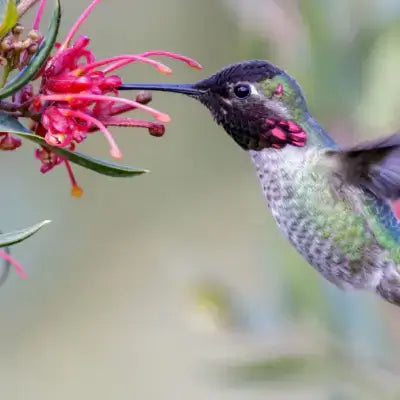
The process of having a hummingbird-friendly garden begins with the selection of the appropriate plants that attract hummingbirds. These lively birds are attracted to tubular flowers full of nectar, bright colors such as red and orange, and gardens that provide them with a constant food supply. With the appropriate choice of attracting hummingbird plants, you will have better results in terms of pollination, natural control of pests, and a healthy ecosystem in your own backyard.
At TN Nursery, we have been working to turn the outdoor gardens of the gardeners into homes for the wildlife over the years. This reference includes seven popular plants that attract hummingbirds naturally to your yard.
Why Do Certain Plants Attract Hummingbirds?
Their tubular-shaped flowers attract hummingbirds with long beaks to reach nectar that other pollinators cannot. The bright colors, especially red, orange, and pink, serve as visual signals of the high-energy nectar rewards.
Flowers that attract hummingbirds usually have a high amount of nectar that contains sugars with concentrations ranging between 15% and 25%. Native species are especially useful since they have developed with the local population of hummingbirds and are in bloom at the species' migration patterns.
To know how to attract hummingbirds requires one to know that they require constant spring blooms all the way to fall. Planting in strategic places makes food available at opportune moments, such as migration periods and nesting, which helps in the continued return of hummingbirds every year.
Top 7 Plant Favorites That Attract Hummingbirds
1. Cardinal Flower
One of the most successful plants, which attracts hummingbirds, is the Cardinal Flower. It has brilliant red tubular blooms that can be seen in late summer, and this offers important nectar to the hummingbirds during their fall migration. It is an indigenous perennial that grows in wet soil and part shade.
The height of a cardinal flower is 2-4 feet, and it flowers between July and September. In TN Nursery, we would suggest planting in clusters of three or more to produce the greatest visual impression and to construct feeding stations that more than one hummingbird can frequent.
2. Trumpet Vine
Trumpet Vine is a climbing plant that is fast-growing with orange and red trumpet-shaped flowers. This giant bloomer contains flowers that are full of nectar (during the months of June through September); hence, it is a long supply of food during the growing period.
It is a sturdy vine that can be used to cover fences, arbors, and pergolas in a very short time, and it forms vertical gardens, which optimizes space utilization. Once established, Trumpet Vine can meet the needs of different soil conditions and survive heat and drought.
3. Larkspur Delphinium
Larkspur Delphinium is an upright flower that exudes elegance with spires of flowers that are blue, purple, pink, and white. These are cool-season bloomers that grow from the end of the spring to early summer, between early bulbs and summer perennials.
Delphiniums are able to grow in cool soil and well-drained soils. Their florets are tubular, which gives ideal landing areas to hummingbirds. TN Nursery suggests planting Larkspur at the back of the borders, where they will make the backdrops dramatic with heights of 3-6 feet.
4. Butterfly Milkweed
Butterfly Milkweed plants attract hummingbirds and butterflies at the same time. It is in bloom between June and August, and its masses of bright orange flowers attract hummingbirds as well as Monarch butterflies.
Butterfly Milkweed is a drought-tolerant and long-lived plant that grows 1-2 feet and has deep taproots. The blooms that are rich in nectar ensure the native ecosystems and offer a lot of energy to the hummingbirds during their high breeding season.
5. Flowering Catmint (Nepeta)
With a little deadheading, Flowering Catmint plants will produce large masses of lavender-blue tubular flowers in the late spring up to fall. It is a low-maintenance perennial with the ability to grow into attractive piles of 1-3 feet and produce nectar pits, which are frequented by the hummingbirds.
Catmint is also heat, drought, and poor soil tolerant, as well as deer resistant. It has significant flowering cycles and is therefore useful when it comes to understanding how to attract hummingbirds when other flowers are not in bloom.
6. Eastern Red Columbine
Eastern Red Columbine is a native wildflower that is characterized by characteristic nodding blooms that are red and yellow in color. These are spring bloomers, when the hummingbirds have just come back to the area, and they give the early-season nectar. The spurred flowers are peculiar and adapted to be pollinated by hummingbirds.
It is a native of the woodland that enjoys partial shade and loose soil with high organic matter content. Columbine is a self-proliferating plant and naturalizes well in shaded gardens, as well as providing hummingbirds with a dependable food source throughout breeding.
7. Bold Perennials
Strong perennials such as Bee Balm, Salvia, and Phlox are permanent in a hummingbird garden. These are dependable bloomers that come back year after year and set up feeding posts, which hummingbirds memorize and come back to. They cluster flowers in the summer and offer a lot of nectar when hummingbirds are rearing young.
We have found that gardens planted with a variety of perennial species provide more hummingbirds throughout the season at TN Nursery. Bold perennials have large root systems, which enhance the soil structure and provide a stable environment for the whole garden ecosystem.
A Step-by-Step Guide to Creating the Perfect Hummingbird Haven
Choose a Sunny Location
The best blooming flower plants that attract hummingbirds need 6-8 hours of direct sunlight a day. Choose garden spots that are well exposed to the sun and are not blown away by strong winds.
Plants that grow higher should be placed in the background, with medium-height plants such as Cardinal Flower in the middle ground and lower-rise plants like Catmint along the foreground.
Prepare the Soil
Prepare planting beds with worm compost or aged organic material to enhance the soil structure and fertility. Most hummingbird plants require good drainage. Adjust the pH of the test soil and test the pH if needed, and most plants that attract hummingbirds thrive in slightly acidic or neutral (pH 6.0-7.0) soils.
Plan for Continuous Blooms
Plants with a delayed blossom to extend nectar throughout spring and fall should be chosen. The initial bloomers include Eastern Red Columbine, and then come the genus Cardinal Flower and Butterfly Milkweed, which are favorites in the summer.
Combine several of the same species of plants to form concentrated sources of nectar. TN Nursery suggests an odd number (3, 5, or 7) of plantings in order to enjoy beauty as well as to be economical in feeding.
Add Water Features
Add a shallow water feature such as a fountain, mister, or dripper. The hummingbird prefers to fly in the fine sprays of water in order to bathe and drink. Locate water areas close to flora areas to form complete habitat stations.
Avoid Pesticides
There are chemical pesticides that are toxic to hummingbirds, indirectly by destroying tiny insects that they consume as sources of protein. Adopt organic farming in which useful insects are nurtured and natural pests are kept at bay. Such a direction is in line with the ideas of sustainable gardening of the TN Nursery.
Provide Perching Spots
The hummingbirds require bare branches or fine wires around them that they can use to rest between feeding escapades. Keep a few dead branches on bushes or place some ornamental garden posts on which to perch close to a feeding place.
Conclusion
Planting a garden inhabited by plants that attract hummingbirds would turn your yard into a rich wildlife refuge. With your selections of the time-tested, common cardinal, Trumpet Vine, Larkspur Delphinium, and Butterfly Milkweed, you will have season-long flowers, enhanced pollination, and the enchanted company of these jewel-tongued birds.
TN Nursery can provide you with plants that are nurtured by experts and can grow well and flourish in your garden, including hummingbird-friendly plants. Hummingbird Haven can be found in any landscape, and starting yours today can be very joyful.
FAQs
What is a hummingbird's favorite plant?
Cardinal Flower is also one of the best favorites because of the bright red tubular flower and the nectar richness during the migration period.
Are native plants better for attracting hummingbirds?
Yes, the native plants, such as Cardinal Flower and Butterfly Milkweed, also grow at the most important times of migration and offer the most notable nectar.
Do hummingbird plants need full sun?
A vast majority of the hummingbird-attracting plants require 6-8 hours of sun exposure per day, although some, such as Eastern Red Columbine, are partial-shade.
How long does it take to attract hummingbirds to a garden?
Hummingbirds may be found in just a few days when plants are in blossom, though a consistent population cannot be achieved in a single growing season.
Can perennials attract hummingbirds every year?
Yes, perennials are the ones that come back with more and more blooms every year, thus providing consistent long-term hummingbird habitats.
Where can I buy hummingbird-friendly plants online?
TN Nursery sells quality plants that attract hummingbirds, such as Cardinal Flower, Trumpet Vine, Larkspur Delphinium, and Butterfly Milkweed, among others, across the country.


