
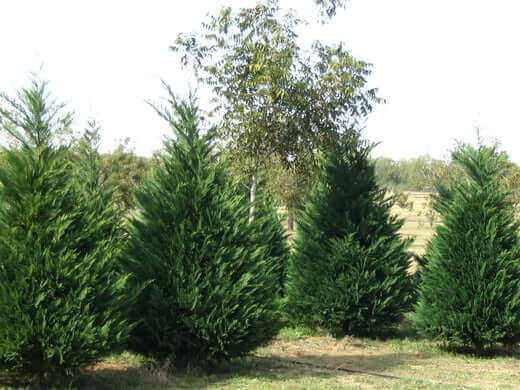
Leyland Cypress: No-Fuss Living Privacy Fence
Picture yourself in your backyard: it’s a hot summer day and you want to cool off in your sparkly swimming pool or relax in your hot tub. You might even want to enjoy your beautiful garden. That dream becomes a lot more difficult to fulfill when your backyard is exposed to your neighbor’s yard. Privacy in your backyard can feel impossible. Fortunately, backyard privacy is a dream that can be turned into a reality.
In the past, people have gotten a wooden or vinyl privacy fence, but there are better options. These types of fences can be great, but the initial installation is expensive and upkeep is needed throughout the year. Expenses that will constantly be taken are the money and time that will be needed to stain, paint, and repair the fence as time goes on. Is there a better way to do it? Yes! There is a natural alternative that not only looks better, but will need less maintenance and only gets better with age.
Enter the Leyland Cypress, a gift from nature to those who want an added layer of solitude from the outside world. This rapidly growing evergreen, a living wall, offers protection year-round. This tree is an enhancement to the scenery of the property which decreases the need to put up the traditional fences.
What is the reason behind the uniqueness of the Leyland Cypress?
The Leyland Cypress, or x Cupressocyparis leylandii, is a combination of two conifers, the Monterey Cypress and the Nootka Cypress. This combination results in a tree that is well known for its pleasantly fast growing, thin, and leafy branches.
HollyWhat is the most engaging attribute of the Leyland Cypress? The fast growing nature of the tree. In perfect growing conditions, the Leyland Cypress Leyland Cypress can grow up to 4 feet in a year. This means, within a few years, a young tree can grow into a hedge that is protectively dense and impossible to see through. This tree saves a lot of time growing privacy for an area.
Another advantage is definitely their foliage. The leaves are a soft flat spray of green that is kept all year round. Their evergreen nature means that your privacy is not a seasonal luxury; it is a year-round guarantee. The thick branches not only block sight lines; they also help to absorb sound for a more peaceful and tranquil backyard. The traffic and neighborhood chatter are more muffled behind your leafy wall.
Living FencePlanning on Your Living Fence
Using Leyland Cypress for a privacy screen is an easy endeavor, however, a bit of planning is necessary. Correct spacing is a requirement for the health and effectiveness of your hedge. If you plant too closely, they will be in competition for sunlight and water and nutrients, and the lower branches may die which will cause a gap in your hedge.
When creating a dense screen people often recommend spacing the trees six to eight feet apart. If you're willing to wait longer for the trees to fill in though, consider extending that spacing to ten feet. It's important to consider how large the trees will be when they mature though. If unpruned, they will grow to be about 60-70 feet tall and 15-20 feet wide. Keeping a regular trimming schedule will help keep the hedge at a more desired height and width.
Leyland cypress thrive off a variety of soil. As for their sun exposure they will do better with full sun. When planting, they recommend digging a hole that is twice as wide as the root ball but the same depth. This allows the roots to fully spread out.
Alternatives to the Leyland Cypress
Though great choiceLeyland Cypress is widely used for these purposes and is a great choice, it is not the only thing you can use to develop a natural property screen. Other plants may also be a better alternative to use for your layout depending on your climate, soil, and desired looks.
Arborvitae ‘Green Giant’ (Thuja plicata ‘Green Giant’)
Like Leyland Cypress, this is a rapidly growing evergreen that is good for screening. Its shape is more conical, nicely uniform, and it is [Virtually pest and disease-free].7L and is quite deer resistant, which is a considerable bonus in many places.
Eastern White Pine (Pinus strobus)
If what you want is a softer, more feathery look, then the Eastern White Pine is one of the best choices. It also is a fast grower and is also a dense screen that is beautiful. However, the white pine is known to grow extremely large, and so, it is best for properties that have a lot of room.
Nellie R. Stevens Holly (Ilex 'Nellie R. Stevens')
This holly is a superb option if what you want is a broadleaf evergreen. It has glossy, dark green leaves, and in the winter and fall seasons it has bright red berries which adds a nice seasonal look. It has a dense coverage, and is more easily shaped and contains more compact material than a lot of the conifers.
Wax Myrtle (Myrica cerifera)
This hardy, native shrub is a good choice for a more informal hedge. It is fast growing, tolerant of poor soil and salt spray, and it has very aromatic leaves. It is also a great cover and good habitat for birds.
Each of these plants has different benefits. Depending on your needs and the characteristics of your yard, one option may appeal to you over the others. Everyone wants to set up a living fence that they'll be able to enjoy for a long time, so take the time to investigate your options.
Establishing Your Own Oasis
There’s no need to keep spending your time and effort on a backyard you can’t enjoy! Skip the constant building and upkeep of a wooden fence, and use a more beautiful and natural alternative. With Leyland Cypress trees or other evergreens, you can create a living privacy fence that turns your yard into a secluded retreat. Plus, you’ll be investing in the value of your home and your mental wellbeing.
Are you ready to get privacy and plant some trees? TN Nursery has a huge stock of Leyland Cypress trees and other plants for privacy to help you out. Come check out the plants in our online store and start building your own oasis.
FAQs
Are Leyland Cypress trees good for privacy screens?
Yes, Leyland Cypress trees are great for privacy screens. They are fast-growing, providing a green wall within a few years. They grow a dense layer of evergreen foliage, completely blocking visibility year-round, and suppressing noise.
What are the disadvantages of Leyland Cypress?
Leyland Cypress trees are wonderful for privacy, but there are downsides. They grow extremely fast, which requires pruning to keep at a manageable size. They are also susceptible to disease and root rot, which happens if they are planted close together or in poorly draining dirt.
Can I plant a Leyland Cypress next to a fence?
Yes, but keep in mind that you will need to give the trees enough space. They should be planted 8-10 feet from the fence line to promote good airflow as well as provide you room to trim the back of the hedge, preventing the fence from being damaged as the hedge grows.
How fast does a Leyland Cypress grow?
Perfect sunshine and well-drained soil lets a Leyland Cypress grow 3-4 feet a year! So if you want a fast-growing privacy hedge, Leyland Cypress is a great choice because you will be adding a lot of coverage in a short amount of time.
What are some other fast-growing trees to block neighbors?
A great other option is Arborvitae 'Green Giant' who is very low maintenance and is very healthy and sturdy. For a softer look, the Eastern White Pine is a great choice. For another option with broad leaves and winter berries, go with the Nellie R. Stevens Holly!
What are the disadvantages of Cypress trees?
A few cypress trees, like the Leyland, are prone to common pests like bagworms, and diseases like canker, so be careful! Also some grow very large and if you are in a small yard this can cause extreme issues if you do not take care of the plan. Make sure to have well-drained soil as well to avoid root rot.


