j edward kjerulff jr
They showed up Nicky packed and I put them in the ground staked and watered often now they have new leaves appearing looks like they gonna make it shipping was a little high but they made it and are growing 👍😎

Eastern Redbud Tree
Ships Between November 15-29
4-9
20-30 ft tall, 25-35 ft wide
Low
Full sun and Partial shade
Early Spring
Redbud trees prefer well-drained soil and benefit from regular watering during dry spells. Prune lightly right after flowering to shape the crown and clear dead limbs. Redbud is easy to grow and adapts to many soils.
Eastern redbud grows in full sun to partial shade. Four to six hours of sun a day gives the best flowering, and light afternoon shade suits hot southern gardens.
Ecological significance & aesthetic appeal , Shade and cooling effect, Soil stabilization & carbon sequestration
j edward kjerulff jr
They showed up Nicky packed and I put them in the ground staked and watered often now they have new leaves appearing looks like they gonna make it shipping was a little high but they made it and are growing 👍😎
Pamela C Louks
They look healthy. Roots were still moist when I planted them. Had to wait a few days due to rain and 811 locates.
Eileen Flores
I was looking all over Tennessee and North Carolina for some redbud trees and I couldn’t find them. I saw an ad for TN Nursery, so I did some research. Read some reviews and took the chance! And I’m glad they did! It was an easy process and kept you updated through email! Hope to see lots of blooming flowers come spring!
About this plant
The eastern redbud tree (Cercis canadensis) is a native flowering tree that grows 20 to 30 feet tall and covers its branches in rosy-pink to purple blooms in March and April. Eastern redbud is hardy in USDA zones 4–9 and grows in full sun to partial shade. TN Nursery ships bare-root eastern redbud trees, Buy 1 Get 1 Free.
Eastern redbud belongs to the legume (pea) family, Fabaceae, and is native to eastern and central North America, from southern Ontario and New Jersey to Florida, Texas and northern Mexico. Gardeners also call the eastern redbud tree redbud, red bud and American redbud, and eastern redbud is the state tree of Oklahoma. Pea-like flowers open before the leaves, then glossy, heart-shaped leaves follow and turn yellow in fall.
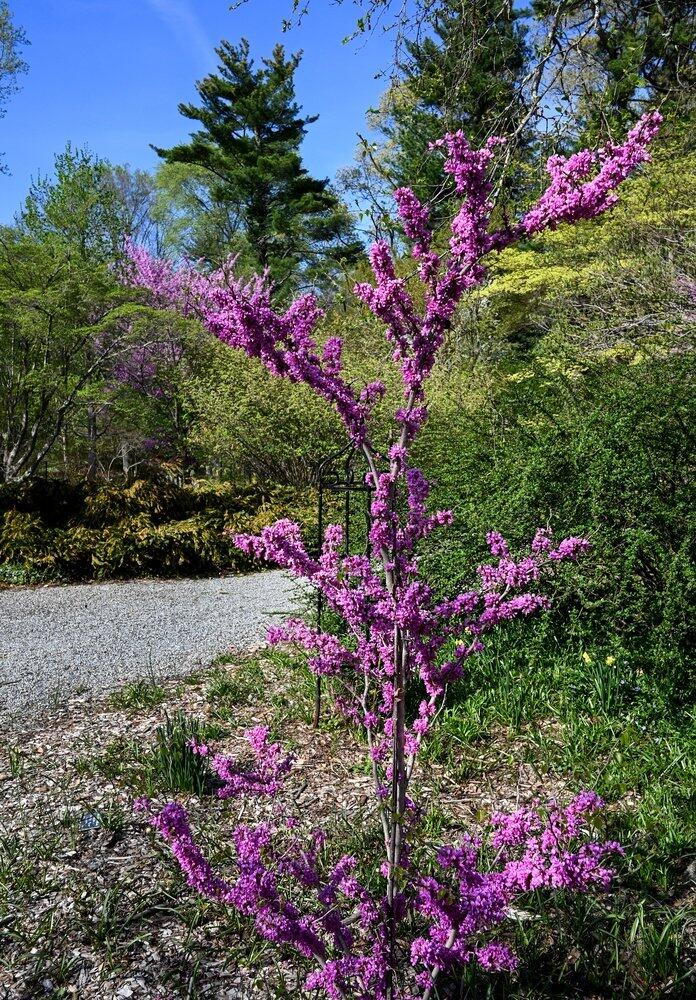
An eastern redbud tree is a small, spreading tree with dark bark, zigzag branches and clusters of bright pink-purple flowers that bloom directly on the branches and trunk in early spring. In summer, the eastern redbud is covered in glossy, heart-shaped green leaves.
Redbud flowers grow along older limbs and even from the trunk, a trait called cauliflory, so the whole tree looks wrapped in color. Flat, bean-like seed pods 2 to 4 inches long follow the flowers and hang on into winter. In fall, the heart-shaped leaves turn butter yellow, and the zigzag branches give the bare tree a graceful winter outline.
Eastern redbud trees grow 20 to 30 feet tall and 25 to 35 feet wide, with a rounded crown that is often wider than it is tall. Eastern redbud grows at a moderate to fast rate of about 1 to 2 feet per year.
| Age after planting | Typical height | What to expect |
|---|---|---|
| Year 1 | 1–4 feet (as shipped) | Leaves in the first spring; roots settle in |
| Years 2–4 | 4–10 feet | First spring blooms on young branches |
| Years 5–10 | 10–20 feet | Full flowering canopy each March–April |
| Mature tree | 20–30 feet | Wide, spreading specimen tree |
The eastern redbud blooms in early spring, in March and April, before the leaves open, and the flowers last 2 to 3 weeks. Eastern redbud is one of the first native trees to bloom each year.
In Tennessee, eastern redbud usually blooms in late March. Bloom time moves earlier in the Deep South and later in the North, reaching late April in zone 4 and 5 gardens. The early flowers give native bees and butterflies some of the first nectar of the season.
Plant an eastern redbud tree in full sun to partial shade, in well-drained soil, at least 10 to 15 feet from buildings. Eastern redbud grows in clay, loam or sandy soil, from acidic to alkaline, as long as the soil drains well.
In the wild, eastern redbud grows along woodland edges, so the tree fits naturally at the border of a lawn, in front of taller trees or as a single lawn specimen. For a row along a drive or property line, space eastern redbud trees 15 to 20 feet apart. Three to five redbuds planted in a loose group look like a small natural grove within a few years.
Spring-flowering trees, evergreens and early bulbs grow well with eastern redbud. A white dogwood tree or pink dogwood tree blooms right after the redbud and extends the spring show. Daffodils and Christmas fern fill the ground beneath young trees. For purple summer foliage, add a Forest Pansy redbud beside the green-leaved eastern redbud. For reforestation, wildlife habitat or a large planting, our eastern redbud seedlings offer the same species in bulk. Browse more spring color in our flowering trees collection.
Plant a bare-root eastern redbud while it is dormant, from November through April, with the root collar at soil level in a hole twice as wide as the roots. Water deeply after planting and weekly during dry spells in the first summer.
At our Altamont, Tennessee nursery, we grow eastern redbud trees in the field, dig them while dormant and ship them bare root. Each tree arrives as a leafless young redbud with its roots packed in moist material, not as the full-grown tree in the photos.
Botanical Name: Cercis canadensis
Plant Family: Fabaceae (legume family)
Ships: Bare root, 1–2 ft, 2–3 ft or 3–4 ft
Planting Zone: 4–9
Height at Maturity: 20–30 feet tall, 25–35 feet wide
Growth Rate: Moderate to fast, 1–2 feet per year
Spacing: 15–20 feet apart
Sun or Shade: Full sun to partial shade
Water Needs: Moderate; drought tolerant once established
Soil: Well-drained clay, loam or sand; acidic to alkaline
Bloom Season: Early spring (March–April)
Flower Color: Rosy pink to magenta-purple
Fall Color: Yellow
Native Range: Eastern and central North America
Care: Prune lightly right after flowering to shape the crown and remove crossing branches.
Plant Attributes: Native, early spring blooms, heart-shaped leaves, pollinator friendly, adapts to many soils
An eastern redbud tree grows about 1 to 2 feet per year once established, a moderate to fast rate for a flowering tree.
Eastern redbud grows in USDA hardiness zones 4 through 9.
Yes. Eastern redbud is a good tree for small yards because the tree stays 20 to 30 feet tall and fits beside patios, along driveways and in front-yard beds.
Prune a redbud tree right after it finishes blooming in spring, so next year's flower buds stay on the branches.
The best time to plant a bare-root redbud tree is during dormancy, from November through April.
Yes. Eastern redbud flowers are edible, with a mild, pea-like flavor, and they add bright color to spring salads.
TN Nursery has grown hardy native plants since 1959, more than 65 years of experience, and has supplied plants to major U.S. landmarks like the Washington Monument and Arlington National Cemetery. At our Altamont, Tennessee nursery, we grow eastern redbud trees in our own fields and ship them bare root during the dormant season. Want to learn more first? Read Radiant Redbud Elegance, 10 Trees That Bloom in Early Spring and Best Spring Blooming Trees on our garden blog, or browse our native trees.

Since 1959, TN Nursery has grown and shipped quality bare root plants nationwide. Shipped during dormancy, bare-root plants develop strong root systems and establish quickly. Our experienced team carefully harvests and packages every order, providing growers with trusted plants backed by over 65 years of nursery experience.
Learn More About
Bare root trees
Beautiful Spring Blooms:
Delicate purple-lilac flowers in early spring create a stunning display.
Heart-Shaped Leaves:
Leaves change from red to green, then to fall colors of yellow and orange.
Graceful Multi-Trunk Structure:
Spreading branches and multiple trunks enhance garden texture and appeal.
Unique Cauliflory:
Flowers can bloom along limbs and trunk, adding visual interest.
Fall Digging
Spring Digging
Packing Orders
Customer Unboxing Video
Product Highlight
Love the Redbud trees I ordered !
Trees were in excellent condition. The trees were exactly as advertised.
This tree arrived in good health and with ample roots. Hopefully blossoms next spring
We received our order in the amount of time specified and received all healthy trees. Loved the buy 1 get 1 deal!
The Redbud Tree I purchased from TN Nursery was perfect from the moment it arrived. It had strong roots, looked fresh, and transplanted easily into my garden. It has quickly adapted and is growing strong. I’m very excited to enjoy its colorful blossoms soon.
My Redbud Tree arrived from TN Nursery healthy, vibrant, and ready to thrive. The packaging kept it safe during transit, and planting was simple. It’s already showing excellent growth, and I’m confident it will produce brilliant pink blooms next spring. TN Nursery provides excellent value and quality.
I ordered a Redbud Tree from TN Nursery, and it arrived in outstanding condition. The roots were healthy, and the tree showed no signs of stress from shipping. It’s now growing vigorously in my backyard. The spring blossoms are sure to be spectacular.
I couldn’t be more pleased with my Redbud Tree purchase from TN Nursery. It was shipped on time, arrived with a strong root system, and transplanted easily. The tree is already flourishing, and I’m eager to see it in full bloom. TN Nursery is my trusted source for high-quality ornamental trees.
The Redbud Tree I ordered from TN Nursery exceeded my expectations. It arrived healthy, carefully packaged, and ready to plant. After just a short time in the ground, it’s thriving beautifully. The vibrant blossoms will bring so much color and charm to my yard every spring.
My Redbud Tree from TN Nursery was shipped quickly and arrived fresh with well-developed roots. It was easy to transplant, and within weeks, I noticed new growth. This tree adds elegance and beauty to my landscape, and I’m excited for its bright spring flowers. TN Nursery consistently delivers top-quality plants.
I purchased a Redbud Tree from TN Nursery, and it arrived in excellent condition. The roots were strong, the packaging was secure, and the tree looked vibrant and healthy. After planting, it established quickly and has already started producing lush green leaves. I can’t wait to see the stunning pink blossoms in the spring.
I ordered one eastern redbud 3-4 ft and definitely received one and to my delight they sent me another one for free. Both of the redbuds were already sprouting and the roots looked healthy. I am grateful for the excellent service and good shipment.
Thank you very much! I will be definitely buying more from your store in the near future!
I'm optimistic that these will work out, as 9 out of 10 survived their first summer. Waiting to hear back on a replacement for the **** one.
They showed up Nicky packed and I put them in the ground staked and watered often now they have new leaves appearing looks like they gonna make it shipping was a little high but they made it and are growing
👍😎
They look healthy. Roots were still moist when I planted them. Had to wait a few days due to rain and 811 locates.
I was looking all over Tennessee and North Carolina for some redbud trees and I couldn’t find them. I saw an ad for TN Nursery, so I did some research. Read some reviews and took the chance! And I’m glad they did! It was an easy process and kept you updated through email!
Hope to see lots of blooming flowers come spring!
I water them every day hoping they stay alive and grow especially during the winter
Redbud Tree
Trees arrived safely. There were actually 4 stems when I only expected 2. Planted immediately. Time will tell if they all grow.
I was not expecting them to be dormant! Maybe it was listed but I ordered from my phone! Fingers crossed they do well here in Texas! Thank you!!
Received my redbud ball root stems in perfect condition. Plan them within 12 hours of receiving them. My last batch of redbud trees are looking great after two years. I will always use the Tennessee nursery for my trees and shrubs source.
the products that t and n sell are alway very healthy, great buy!!!
I purchased 22 trees and remember that I only paid for 11 due to the BOGO they have. 4 types of crepe Myrtle’s and some giant green arborvitae’s. I purchased 6 of the green giants and they sent 8! The crepe Myrtle’s and arborvitae’s were all in excellent shape and were planted same day. I have no doubt they’ll take right off. I have purchased bare root trees from VA dept of forestry (I live in VA) in the past with almost 100% success rate. The trees I just received from y’all were large, packaged great and not damaged at all. Much larger than I had expected and I am excited to see them grow. Thank you and I will be buying from you again for my home and our business.
My plan when I found and ordered my Redbud tree from your nursery was to get my 1 Redbud tree when you offered me a second one free just for purchasing that one beautiful Redbud tree…and they both arrived perfectly packed, ready for planting! Thank you for sending me my two beautiful Redbud trees.
I planted the five trees and will see
What happens
Phil
I bought redbud trees from TN Nursery and they arrived looking good with instructions on how to plant.
Quick delivery, tree looks good, can't wait to see it bloom!
Looks great
My trees arrived in great condition! The shipping was fast. I planted them the next day and can’t wait to see them grow. I’ve bought from this site before and will certainly buy again in the future. Thank you
Lost all my ornamental trees during summer drought. Planting bare root and I will be doing a lot of watering but the trees are great. Thanks tn. Nursery
Well packaged. Just planted and should grow well.
The tree arrived in a timely manner and looked healthy on arrival. I think the planting instructions could have been more detailed and regional. My area of NC is all clay. Not sure it doesn't need special care.